Showing posts with label Environment. Show all posts

Monday, January 18, 2010

Chatting over the fence

I was just sitting outside in the sun on a lounger and ‘chatting’ with a friend from England on MSN when I saw my new neighbour over the fence. I yelled out a friendly ‘hi’ and was surprised to see him scuttle away without replying.

Now there’s a chance he thought I was a cougar on the hunt who’d spied prey separated from the herd but more likely I think it’s about a new social situation; one in which we so easily communicate electronically with people on other continents but not so easily with someone who lives next door.  Have you heard the one about not being able to get in touch with your grandmother because she’s not on Facebook? It makes me wonder what we might be missing out on, surely it must affect our sense of community – or does it? I know I feel a sense of belonging with the volunteer organisation I work with – does that count? Have our communities just moved away from suburbia? Is the workplace perhaps our new community?

OK the neighbour is outside again – looks like he’s planning to do some gardening. I will post this now and at the risk of freaking him out completely, I am going to go and stand at the fence and introduce myself. Horrors.

Monday, January 11, 2010

Protesting yet again

I’m getting picked up any minute by a friend (actually he’s late) to go and add my voice to a protest today outside the office of the Consulate General of Japan.

Any guesses what the issue is?

No points for working out it’s whaling on the agenda yet again. It’s a protest against the illegal slaughter of whales in the Southern Ocean whale sanctuary and the inaction of Japanese and New Zealand Governments to intervene and shut down the massacre.

A petition calling for a firm and diplomatic solution to whaling from both the New Zealand government and Japanese authorities will be presented to a representative of the Japanese Consul. At least the Australian government has been vocal about the recent carry on in Antarctica while my own government has been strangely quiet.

Japanese_Whaling Photo from ataac.org

Sunday, January 3, 2010

Keeping our heads above water

New Zealand has shocking drowning statistics every summer. Kiwis (and our visitors) are far too casual when swimming from our highly tidal beaches with swift currents and fearsome rips.

Piha_and_Lion_Rock Piha, west coast black sand beach, north Auckland. Photo from Wikipedia.

Water Safety New Zealand states that on average 119 people drown in New Zealand waters every year. Only road crashes kill more people accidently. There is a chilling physiological explanation of the drowning process there too if anyone has a morbid curiosity.

All major beaches in New Zealand are patrolled by surf lifesavers through summer but on any given day you’ll see most people swimming well away from the patrolled areas – I think it’s got something to do with the fact that we don’t like being told what to do. The lifesavers do an admirable job of keeping an eye on the whole beach and mostly they’re successful but they’re fighting an uphill battle; we New Zealanders think we’re indestructible because we grew up swimming in the sea.

In the last two days a grandfather and a father have drowned in two separate incidents when they were trying (successfully) to save young children swimming with them. In both cases some foresight about the conditions might easily have prevented them getting into trouble. A teen also drowned jumping from a waterfall.Piha LifeguardsPhoto from throng.co.nz 

What’s really sad is that our visitors die too. Our beaches are beautiful and look harmless so people just run into the water at the closest spot to their towels and umbrella rather than checking out where the rips are. I was pleased to see yesterday when I was at Piha beach that there were lifesavers handing out pamphlets in different languages explaining about currents and rips and what swimmers should look for before choosing where to swim.

New Zealand beaches are safe as long as we’re all sensible, know what to look for, supervise our kids PROPERLY (always use flippers with boogie boards) and stay out of the water after drinking. With little children always head to the safer east coast Auckland beaches. Maraetai_231209_4 Maraetai, east coast inner harbour, Auckland (15 minutes drive east from my place)

EDIT: I just did some research and found that Australia’s latest figures (the year to June 2009) make our figures look even worse. Australia lost 302 people to drowning in that year when of course their population is more than 5 times ours (4m here vs 21m there).

I also note that another person (35 year old male) is missing and now presumed drowned from Piha at about the time I was publishing this post yesterday.

Sunday, November 29, 2009

Does it matter?

More and more bullshit news every day about the questionable climate change science is getting to me. As Moko said from his virtual sandbox the other day;

“These clowns can't see the ocean for the waves.”

Are we polluting our planet? Is this a good thing? What are the chances we can go on doing this forever? Are we creating a healthier environment for our grandchildren and their grandchildren?

I don’t give a shit that some say the science looks dodgy, all I know is that you don’t wait until you figure out how the fire started before you put it out.


Wake up world.

Our livelihood right now is far less important than the next generations being able to breathe and drink fresh clean water.

It’s irresponsible that we’re not doing something significant to limit our impact on this planet – whether the science shows it yet or not. 

Thursday, November 26, 2009

Noooooooooo

An Australian tourist accidentally smuggled a poisonous cane toad into Queenstown inside the hiking boots in her bag last week.

New Zealand Herald article here.

The disgusting critter was discovered after hopping out of the Cairns woman's bag when she stopped by Ultimate Hikes shop ahead of the walk on the Milford Track.

Somehow our Ministry of Ag & Fish officers at Auckland airport missed it. WTF? Please TRY HARDER people. Yuck!

Queensland_Cane_Toad 

Photo from news.mongabay.com and courtesy of FrogWatch, an Australian environmental group that wants to kill all cane toads. Click on the picture for the full July 2008 story.

Wednesday, September 30, 2009

Good vibes

Two of my colleagues are sitting at home with their families right now waiting to hear that missing loved ones on the south coast of Upolu and in a northern Tongan island are okay. Or not okay as the case may be. It’s been a horrible day. Though New Zealand has been unaffected geographically, many Samoan and Tongan kiwis have friends or family back in the islands who’ve experienced property damage and worse.

Sending good vibes to all the Samoan, Tongan and Cook islands.

Thursday, September 17, 2009

Thursday sunset

Driving home from a friends place earlier this evening I got a nice shot of a pretty pink sunset. Mt grandmother used to always say that ‘a red sky at night is a shepherds delight‘ so I am hoping that means that we might be in for another beautiful spring day in Papakura tomorrow. Have a great Thursday everyone.

Sunset_170909

Friday, July 17, 2009

Rock and roll

You may have heard that NZ’s been getting a good shake up over the last few days. We’ve had around 30 decent shakes plus hundreds of small ones following the big one on Wednesday which measured 7.8 on the Richter scale.  I felt the ground rumble briefly this morning and it prompted this post on the subject.

A 7.8 quake is pretty massive, in fact it was this magnitude quake that killed 240,000 people in 1976 in Tangshan, in north-eastern China. The Japanese Kobe quake was a 7.2 and nearly 7000 lost their lives. Luckily the quake this week had an epicentre in NZ’s most sparsely populated region at the very bottom of the South Island. It was only 12 kilometres down too which is extra dangerous. By all accounts it lasted nearly 30 seconds which is a very long time by earthquake standards. It was a ‘rolling’ quake rather than a shake which means the ground appears to move in a wave formation – I saw one years ago and I’ll never forget it.  TectonicsNew Zealand straddles the Indo-Australian tectonic plate and the Pacific plate. These are 2 of the 15 plates on the Earths surface. The plates are enormous, rigid plates of rock up to 100km thick. These plates are always moving and at their edges they are constantly grinding into each other. This movement causes stress to build up in the brittle, upper layers of the plates. When this brittle rock finally breaks, an earthquake results.

The Pacific plate is forcing itself under the Australian plate at a rate of about 48-50mm a year. The Pacific plate can move this fast because it carries only a minimal amount of land mass. The edges of the Pacific plate form what is known as ‘the ring of fire', a zone of frequent earthquakes and volcanic eruptions stretching from New Zealand’s Southern Alps mountain range across to Washington state’s Mt St Helens. The image below shows the location of volcanic areas along the rim of the Pacific plate. ringfireThe city I live in, Auckland, has around 50 volcanoes. In theory they are classified as dormant though in practice they are unlikely to erupt again. More likely is the formation of new volcanoes due to Auckland's position on a magma ‘hot spot’.

Never a dull moment.

Monday, July 13, 2009

International year of astronomy

Church of the Good ShepherdChurch of the Good Shepherd, Tekapo, Mackenzie Country, NZ. Photo: Associated Press

People's ability to see starlight is in increasing danger due to light pollution and pollution of the air. Many people around the world cannot see stars anymore because of night light pollution.

Our beautiful Mackenzie Country still has a pristine dark sky and the Tekapo area is currently bidding for world night sky reserve status, one of eight world-wide night UNESCO heritage site bids. Capture2

The Mount John Observatory, located above Lake Tekapo near Mount Cook in the South Island,  is home  to six telescopes, including NZ’s biggest telescope which measures 1.8m across and can observe 50 million stars each clear night. There are fears that the night sky will be compromised in the future by light pollution emanating from encroaching housing developments. Development must be very carefully managed and this is where the heritage protected status comes in.  It would be a terrible pity if we were all to lose sight of the beautiful night sky. 

Mt  John ObservatoryPhotographer unknown but see http://www.laketekapo.cc/star.html where I found this one and many other awesome photos.

Monday, July 6, 2009

Stingray for breakfast

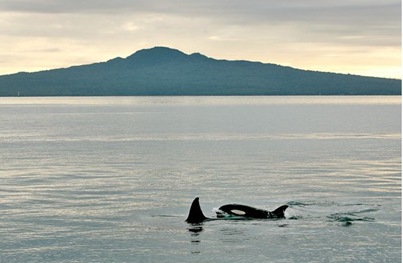
The Waitemata harbour in Auckland has been host most mornings recently to a pod of up to 18 Orca who are on the hunt for stingray. The Orca are coming right into the shallows by the city beaches and putting on quite a show.

Thought I’d share some of the photographs that are around, none of which are mine as unfortunately my pitiful attempts aren’t worth viewing. It’s mid winter here and freezing so forgive the dull early morning weather. At least it wasn’t raining.

Photo by Jonathan Squires


Photo: Jonathan Squires


Photo by Glenn McNae Photo: Glenn McNae

Photo by Brett Phibbs Photo: Brett Phibbs

Photo by Brett Phibbs_2Photo: Brett Phibbs

Apparently stingray are an Orca delicacy, they herd them into the shallows and it’s all on. They mainly eat the liver and leave the rest which worries the biologists as any toxins that the rays have been exposed to would be filtered by the liver and thus ingested by the Orca. At one stage when we were there multiple rays were leaping from the water trying to get away. Amazing stuff, dangerous too as I read that the barb of a stingray can kill even an Orca. Fascinating. Gruesome.

Sunday, June 28, 2009

What’s the buzz?

New Zealand has no native bumblebees or honeybees (which live in colonies) but we do have several species of native bee that live in individual holes in clay banks.

Bumblebees of various species were introduced to New Zealand from England but the short-haired bumblebee pictured below, is the rarest here. They were brought to New Zealand from England over 120 years ago to pollinate red clover. Buzzy Bee


Associated Press 


These particular bees are now extinct in England and UK conservation groups have announced a programme to create a secure home on farms in southeast England and then start a captive breeding programme using bees from New Zealand.

Bees will be caught in Central Otago in the South Island  and will wake up in England after being flown back in cool boxes during their winter zzzzz’s (aka hibernation).

Interesting thought that they’ll be repatriated after hundreds (thousands??) of generations here.  I wonder if other breeds of local English bees will look down on them as backwater colonials and quietly mock their accents?

Wednesday, April 22, 2009

Collateral damage

  • 24 albatrosses
  • 32 shags
  • 5 endangered yellow-eyed penguins (hoiho)
  • 9 common dolphins, 3 fur seals and 1 great white sharkRoyal Albatross

This is the ‘by-catch’ of set-net fishing boats in our coastal waters in one recent two month period, reports the NZ Herald.

The Ministry of Fisheries has run an observer programme on all New Zealand set-net boats. The by-catch was recorded and the results are much worse than was thought. 

24 albatrosses? That blows me away as I’m sure it would anyone who’s ever seen one of these magnificent birds.

The fishing industry and the Department of Conservation continue toHectors Dolphin “…look at the merits of various ideas to reduce unintended catch”. Some improvement has already been made in managing seabird by-catch but Forest and Bird rightfully continue their call for a nationwide ban on set nets in an effort to further reduce the carnage.

Good work is going on to protect our tiny endangered Hector’s dolphins and the almost extinct Maui dolphins (only 111 left at last count) but is it too late? 

Read more here.

Friday, April 10, 2009

So far from home

Ed Reynolds, 39, engineer, from Pennsylvania is missing, feared dead, in the harsh New Zealand bush. Edward ReynoldsThough an experienced trekker, it was his first time in NZ so he wouldn’t have previously experienced the extreme changeability of NZ weather.

Ed was notified as missing by his American family after failing to make his flight out of NZ in late March. The last sighting of him was in late February when kiwi father and son trampers crossed paths with him.  He was in good spirits but they were worried he was travelling so lightly and warned him about the bad weather that was forecast. His bank account has not been touched since he went bush.

He’s in this area somewhere. Ada PassBad weather is continuing to hamper the search efforts. The fact that he was an ‘ultra light’ tramper (i.e one who travels with the absolute minimum weight of food and equipment) does not work in his favour.

Apparently the family are on their way here to be closer while the search continues. I sincerely hope they get to take their boy home with them. One way or another.

Friday, March 20, 2009

Brotherly love – yeah right!

I cannot believe I haven’t seen or even heard of this before. I came across it on YouTube quite by accident.  For those who don’t know, the second part of this ad is a spoof of a NZ advertising campaign trying to get Australians to holiday here.

Did this really air on Australian TV?

I’ve been sharing it with some Kiwi friends and no-one I know has ever seen it before. Is very very funny. Love it. There’s no denying that Australians have a great sense of humour and especially so when it involves taking the piss out of Kiwi’s.

That’s all for today folks as I am shattered. I had to commute to Wellington twice this week which makes a 15 hour work day each time on top of the rest of a very stressful and busy week.

Heading to bed now to watch a bit of TV and read a couple of chapters of my book before sleep time.  Totally out of control social life ay? 

TGIF       

Monday, March 2, 2009

The Issue of Tissue

I was shopping with my mum earlier this evening and I was surprised to see her reach for non-recycled paper toilet tissue. She always used to have an earth friendly brand in the bathroom but she says she’s gone back to buying a luxury brand as she likes how soft it is and that it’s too scratchy when the Toilet Paper paper is recycled. I proceeded to rip open a pack of recycled non-bleached tissue like we use in our house to show her that it’s not that bad – it’s not like sand paper like it used to be years ago when they first started selling it.

End result, she’s taken some home to try again.

After our conversation I stood there and scanned the shelf in the supermarket and was surprised to see that nearly a quarter of the brands on offer had only a small (or even worse, zero) percentage of recycled paper used in the manufacture. I was embarrassed. I came home and googled the issue thinking how awful that there’s still obviously a quarter of people in NZ using virgin wood pulp to wipe their arse (please excuse my coarse language). Surely the rest of the world would be Canadian Boreal Foresthorrified when we’re supposed to be all ‘clean and green’ here in NZ. Yeah, right!

Well……this is an article that I found. 98% of toilet tissue sold in the US today is from non-recycled paper.

Don’t worry I’m not going to deliver a lecture but I just thought I’d bring it to your attention. Do what you will with the information :-)

Canadian readers though, might be interested to know where some of the 200 year old trees come from to make this fluffy, multi-ply luxury so favoured in North American bathrooms.